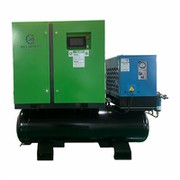
Analysis of High-Efficiency Operation Techniques for Permanent Magnet Variable Frequency Screw Air Compressors
Oct 17, 2025
Permanent magnet variable frequency screw air compressors, as representative high-efficiency and energy-saving equipment in modern industry, have become the core choice for many enterprises' compressed air systems due to their stable air supply performance and significant energy consumption advantages. However, to fully realize their technological potential, it is not only necessary to rely on the quality of the equipment itself, but also to combine scientific operating techniques and maintenance strategies. The following systematically elaborates on the key methods for improving the efficiency of permanent magnet variable frequency screw air compressors from the dimensions of parameter setting, operation management, maintenance, and fault prevention.
Precisely Matching Operating Parameters to Optimize Energy Efficiency
The core value of permanent magnet variable frequency technology lies in its ability to precisely match changes in air demand by adjusting the motor speed in real time, thereby avoiding energy waste in the "full load-unload" mode of traditional fixed frequency models. To achieve this goal, it is first necessary to set reasonable operating parameters according to the air consumption characteristics of the actual production scenario (such as peak flow rate, stable air consumption, and pressure fluctuation range). For example, setting the air compressor's "target pressure band" (i.e., pressure control range) slightly higher than the minimum pressure required by the production equipment (a margin of 0.1-0.2 MPa is generally recommended) allows the unit to maintain low-speed operation as much as possible while meeting demand. This not only reduces motor energy consumption (energy consumption decreases by approximately 15%-20% for every 10% reduction in speed) but also reduces wear on mechanical parts.
Furthermore, for systems with multiple air compressors operating in parallel, it is recommended to designate the permanent magnet variable frequency unit as the main unit (responsible for basic load regulation), supplemented by a fixed frequency unit (to handle sudden peak demand). By using an intelligent control system to prioritize responses to minor pressure fluctuations, while the fixed frequency unit only starts when air consumption increases significantly, the overall system's energy efficiency ratio can be further optimized.
Dynamic Operation Management, Extending Equipment Lifespan
In daily use, the level of precision in operation management directly affects the reliability and lifespan of the equipment. First, frequent start-stop cycles must be avoided. While permanent magnet motors are tolerable for frequent start-stop cycles, excessively frequent operation (e.g., more than 3 times per hour) can still lead to inverter overheating or stress buildup in the motor bearings. It is recommended to use an air tank to buffer gas usage fluctuations and maintain each run for at least 30 minutes to balance efficiency and equipment protection.
Second, Real-time Pressure And Current Data Must Be Closely Monitored
During normal operation, the exhaust pressure should be stable within ±0.05 MPa of the set value. If persistent overpressure or underpressure occurs (deviation exceeding 0.1 MPa), check for leaks in the pipeline, abnormal load on the air-using equipment, or malfunctioning pressure sensors. Simultaneously, the motor's operating current should not exceed 85% of the rated value for extended periods (this can be monitored via the inverter panel). An abnormally high current may indicate a clogged intake filter, dust accumulation on the radiator, or increased load due to rotor wear, requiring prompt investigation.
Third, Systematic Maintenance Is Crucial For Stable Performance
Maintenance of permanent magnet variable frequency screw air compressors should focus on three key aspects: cleaning, lubrication, and inspection. The intake system is the first line of defense-if dust and impurities in the air enter the main unit, they will accelerate rotor wear and reduce compression efficiency. It is recommended to clean the intake filter every 200-300 hours of operation (shorter intervals in harsh environments), replace the high-efficiency filter every 2000 hours, and regularly check the intake valve's seal to prevent unfiltered air bypass.
The Lubrication System Is The Core Guarantee
Permanent magnet inverter models typically use special synthetic lubricating oil (high temperature resistance and anti-emulsification properties superior to ordinary mineral oil). It must be changed strictly according to the manufacturer's recommended model and cycle (generally every 2000-3000 hours or every six months). When changing the oil, the oil separator and oil lines should be cleaned simultaneously to avoid old oil residue causing a decline in the performance of the new oil. In addition, the oil level should be checked regularly (observe after 15 minutes of shutdown; the oil level should be at the center line of the sight glass). If the oil shows signs of emulsification (whitening), blackening, or impurities, the machine must be stopped immediately for treatment.
Maintenance Of The Main Unit Rotor Is Equally Crucial
Although the rotors of permanent magnet variable frequency screw compressors are machined with high precision (gap controlled at the micrometer level), efficiency may still be affected by carbon buildup or wear after long-term operation. It is recommended to perform rotor gap testing at least once a year (measuring the fit clearance between the male and female rotors and the housing using professional instruments). If the gap is found to exceed 15% of the initial value, it is necessary to consider returning the unit to the factory for repair or replacement of the rotor assembly.
Proactive Fault Prevention to Reduce Downtime Risk
The intelligent characteristics of permanent magnet variable frequency units facilitate fault prediction-potential problems can be identified in advance by using historical data stored in the inverter (such as temperature curves, current fluctuations, and alarm records). For example, if the inverter frequently reports "over-temperature protection" (ambient temperature exceeding 40℃ or cooling fan failure are common causes), the cooling system should be checked: clean the oil and dust from the radiator surface (using compressed air to blow it back) to ensure unobstructed airflow; if the ambient temperature is too high, an air conditioner or a deflector fan can be installed to control the temperature around the unit below 35℃.
In addition, the risk of demagnetization of the permanent magnets should be given special attention. Although high-performance neodymium iron boron permanent magnets have strong anti-demagnetization capabilities, irreversible demagnetization may occur under extreme high temperatures (above 150°C) or severe vibration environments, leading to a decrease in motor output power. Therefore, during daily operation, it is necessary to avoid prolonged overload operation of the air compressor (exhaust pressure exceeding the rated value by more than 10%), and regularly check the installation foundation of the unit (levelness deviation not exceeding 0.1mm/m) to prevent mechanical damage caused by resonance.
The efficient operation of permanent magnet variable frequency screw air compressors does not solely depend on equipment performance, but also requires operators to master scientific operating techniques and systematic maintenance logic. Through precise parameter settings, dynamic operation management, standardized maintenance procedures, and proactive fault prevention, not only can energy consumption costs be significantly reduced (overall energy saving rate can reach 30%-50%), but the service life of the equipment can also be extended to more than 10 years, ultimately maximizing the full life cycle value of the enterprise's compressed air system.