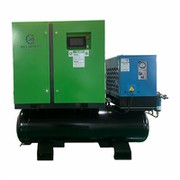
Value Analysis of Permanent Magnet Variable Frequency Screw Air Compressors
Oct 16, 2025
In modern industrial production, compressed air, as the second largest energy source after electricity, directly impacts a company's production costs and operational quality due to the efficiency and reliability of its supply system. As a new generation of high-efficiency and energy-saving air compression equipment, the permanent magnet variable frequency screw air compressor, with its technological innovation and performance advantages, is becoming a core choice for optimizing energy utilization and reducing operating costs in the industrial sector. Its value is not only reflected in direct energy savings but also in the multi-dimensional comprehensive benefits released through intelligent control, stable air supply, and long-term economic efficiency.
I. Energy Saving and Consumption Reduction: The Direct Value of Core Technology
The core value of the permanent magnet variable frequency screw air compressor stems primarily from its groundbreaking energy-saving performance. Traditional fixed-frequency air compressors maintain pressure by operating at a constant speed, maintaining full-load output even when load demand fluctuates, resulting in significant energy waste. Permanent magnet variable frequency technology, however, adjusts the motor speed in real time through a frequency converter, precisely matching air demand-when air demand decreases, the air compressor automatically reduces speed and output; when air demand increases, it quickly responds by increasing power, always maintaining a balance between supply and demand.
This on-demand operation mode increases the average load rate of air compressors from 60%-70% for fixed-frequency compressors to over 90%, significantly improving energy utilization. Data shows that compared to fixed-frequency models of the same specifications, permanent magnet variable frequency screw air compressors can reduce energy consumption by 30%-50%, and even more under certain operating conditions. Taking a 100kW air compressor as an example, if it operates for 8000 hours per year, a fixed-frequency compressor consumes approximately 800,000 kWh annually, while a permanent magnet variable frequency model only requires 400,000-560,000 kWh. A single unit can save a company 200,000-400,000 yuan in electricity costs annually (calculated at an industrial electricity price of 0.8 yuan/kWh).
More importantly, its high-performance permanent magnet synchronous motor (PMSM) uses neodymium iron boron rare earth materials, boasting high magnetic energy product and strong anti-demagnetization capabilities. It maintains stable output even at low speeds, avoiding the efficiency degradation problem caused by slip changes in asynchronous motors during variable frequency speed regulation, further enhancing energy-saving effects.
II. Intelligent Control: Flexibility Advantages for Complex Operating Conditions
Industrial production often involves intermittent and fluctuating air demand (e.g., production line start-up and shutdown, equipment mold changes). Traditional air compressors rely on manual experience or simple pressure switch adjustments, making precise matching difficult. Permanent magnet variable frequency screw air compressors, through the integration of pressure sensors and intelligent control systems, can monitor pipeline pressure in real time and dynamically adjust operating parameters, controlling pressure fluctuations within ±0.01MPa, far exceeding the industry standard (±0.05MPa).
This high-precision control not only avoids energy waste caused by excessive pressure (energy consumption increases by approximately 7%-10% for every 0.1MPa increase), but also protects end-user equipment (such as precision pneumatic tools and sensors) from pressure shock damage, extending their service life. Furthermore, the intelligent system supports multi-unit coordinated control, automatically allocating the operating status of individual equipment according to the total load (e.g., master/slave switching, gradient load increase/decrease), further optimizing the overall system's energy efficiency.
For multi-shift, multi-process production scenarios (such as automotive parts manufacturing and electronic packaging), permanent magnet variable frequency air compressors can also memorize air consumption patterns for different time periods through preset programs, adjust operating strategies in advance, and achieve intelligent management with "unattended operation," reducing labor maintenance costs.
III. Stability and Reliability: Extending Equipment Lifespan and Reducing Maintenance Costs
The long-term stability of equipment is one of the key considerations for enterprises when choosing air compressors. The core components of permanent magnet variable frequency screw air compressors (such as the main unit, motor, and bearings) all adopt high-precision design and high-quality materials: the screw main unit uses imported profiles from Germany or Japan, with small gear gaps, low leakage, and high volumetric efficiency; the permanent magnet motor is directly connected to the main unit (no belt drive), eliminating energy loss and failure risks caused by belt slippage and wear; at the same time, the soft-start function under variable frequency drive (starting current ≤ 1.2 times the rated current) significantly reduces the impact of the power grid and the wear of mechanical parts (such as bearings and shaft seals), extending the overall lifespan of the equipment (typically more than 10 years, more than 30% longer than fixed frequency machines). In terms of maintenance, the application of permanent magnet variable frequency technology reduces the high-temperature and high-pressure cyclic stress caused by frequent loading and unloading, and lowers the rate of lubricant deterioration and filter replacement frequency (some users have reported that the maintenance cycle has been extended from 3 months to 6-8 months). Furthermore, the intelligent diagnostic system can monitor parameters such as motor temperature, vibration value, and current waveform in real time, providing early warnings of potential faults (such as bearing wear and winding abnormalities), helping companies develop preventative maintenance plans and avoid production losses caused by sudden downtime.
IV. Long-Term Economic Efficiency: Optimization of Life Cycle Cost
Although the initial investment of a permanent magnet variable frequency screw air compressor is 15%-25% higher than that of a fixed frequency model (mainly due to the cost of permanent magnet materials and control systems), its life cycle cost (LCC) advantage is extremely significant. In addition to the direct energy-saving benefits mentioned above, the benefits also include:
• Electricity cost savings: Electricity costs account for 70%-80% of the total compressed air costs for industrial users. Energy savings of 30%-50% mean the equipment price difference can be recovered within a few years.
• Reduced maintenance costs: Reduced frequency of replacement of vulnerable parts and repair expenses result in an average annual decrease in maintenance costs of approximately 20%-30%.
• Optimized space and installation costs: Some models, due to their compact design (such as integrated frequency converters), can save on infrastructure investment in power distribution rooms and piping layouts.
Taking a medium-sized manufacturing enterprise as an example, after replacing five fixed-frequency air compressors with permanent magnet variable-frequency models, the cumulative electricity cost savings exceeded 1.8 million yuan within three years, and maintenance costs decreased by 400,000 yuan. The overall investment payback period is only 2.1 years, with continuous net benefits generated for the following seven years.
Conclusion: The value of permanent magnet variable-frequency screw air compressors is essentially a concentrated reflection of industrial production's demand for "high efficiency, intelligence, and sustainability." It not only solves the energy consumption pain point of traditional equipment through technological innovation, but also creates a quantifiable competitive advantage for enterprises with its flexible control, stability, reliability, and long-term economic benefits. Driven by the "dual carbon" goal, and with increasingly stringent energy efficiency standards and continuously rising energy costs, permanent magnet variable frequency screw air compressors will become an inevitable choice for industrial enterprises to upgrade their compressed air systems, and their value will be further released with technological iteration.