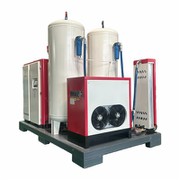
Analysis Of The Manufacturing Process Of Permanent Magnet Variable Frequency Screw Air Compressors
Sep 18, 2025
As a high-efficiency and energy-saving industrial gas compression device, the manufacturing process of permanent magnet variable frequency screw air compressors integrates precision manufacturing, motor technology, and intelligent control systems. Strict adherence to standardized operations is required to ensure product performance and reliability. The following explains the key stages from core component manufacturing to complete machine assembly.
Core Component Manufacturing
1. Screw Compressor Machining
The screw compressor is the power core of the air compressor, and its machining accuracy directly affects energy efficiency and lifespan. The manufacturing process includes:
• Material selection: High-strength alloy steel (such as 20CrMoTi) is used, and internal defects are eliminated through forging;
• Rough machining: The rotor profile is rough milled using a CNC lathe, leaving a margin of 0.3~0.5mm;
• Precision grinding: The rotor meshing surfaces are machined using a five-axis CNC grinder, with a profile accuracy of ±0.01mm and a surface roughness Ra≤0.4μm;
• Dynamic balancing: The rotor counterweight is adjusted on a high-speed dynamic balancing machine to ensure that the operating vibration value is ≤0.5mm/s.
2. Permanent Magnet Motor Production
Permanent magnet synchronous motors are key to achieving frequency conversion and energy saving. Key technological aspects include:
• Magnet Assembly: N52 grade neodymium iron boron permanent magnets are selected, magnetized, and embedded in the stator slots. Epoxy resin is used for potting and fixation, achieving a temperature resistance of 180℃ or higher.
• Winding: Stator coils are wound using an automatic winding machine, with wire diameter tolerance controlled within ±0.02mm. Insulation class is H (temperature resistance 180℃).
• Performance Testing: No-load current and back electromotive force (EMF) waveforms are tested using an electrical parameter analyzer to ensure efficiency ≥96%.
System Integration and Assembly
Frame and Housing Manufacturing
• Sheet Metal Processing: Materials are cut using a laser cutting machine and formed using a bending machine. Housing thickness is ≥3mm. After welding, annealing is performed to relieve stress.
• Sealing Treatment: The inner wall is sprayed with an anti-rust coating, and O-ring seals are installed. The airtightness test pressure is 1.5 times the rated pressure, and no leakage is observed after 30 minutes of pressure holding.
Assembly Process
1. Main Unit Positioning: Connect the screw compressor and motor coaxially using a flexible coupling, with a concentricity deviation ≤0.03mm;
2. Piping Installation: Components such as the intake valve and oil-gas separator are laid out according to ISO standards. The pipe inner diameter matches the flow rate to reduce pressure loss;
3. Electrical Wiring: Shielded cables are used for the inverter and motor cables, with a grounding resistance ≤4Ω to avoid electromagnetic interference;
4. Cooling System: For air-cooled models, install the radiator and test the airflow velocity ≥6m/s. For water-cooled models, connect the circulation pipeline and check for leaks.
Commissioning and Quality Control
1. Performance Testing
• No-load Operation: Check bearing temperature rise (≤60℃), abnormal noise, and vibration;
• Load Testing: Gradually load to the rated pressure to verify that the exhaust volume and specific power meet GB/T 3853 standards;
• Variable Frequency Function: Pass the 0~100% load step test, with a response time ≤0.5 seconds and a speed adjustment range of 1000~7000rpm.
2. Reliability Verification
• Accelerated Life Testing: 500 hours of continuous operation simulating high-load conditions;
• Factory Inspection: Each unit undergoes 100% airtightness, insulation resistance, and safety protection device (e.g., high-temperature shutdown) testing.
The production process of permanent magnet variable frequency screw air compressors relies on high-precision machining equipment, strict tolerance control, and a systematic testing process. By optimizing rotor profile design, permanent magnet motor efficiency, and intelligent variable frequency control, high-performance products with energy efficiency level 1 (specific power ≤ 5.5kW/(m³/min)) are ultimately achieved, meeting the energy conservation and emission reduction needs of the industrial sector.